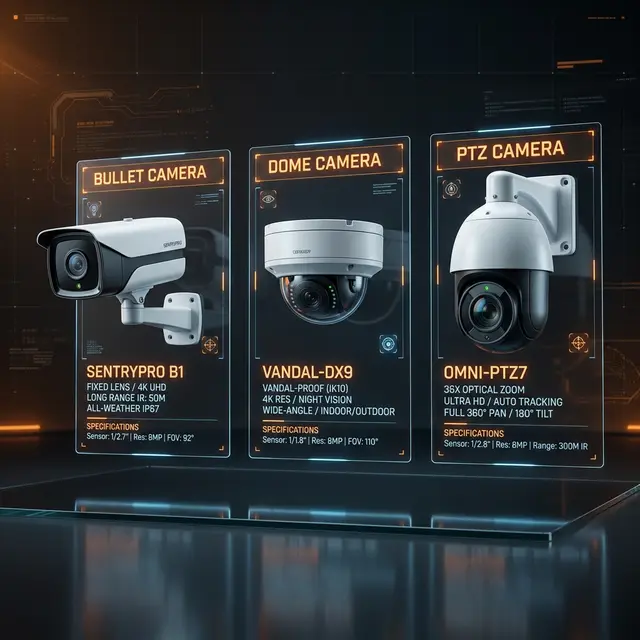
5 mistakes people make when installing security cameras

Discover the most common mistakes that make your security systems worthless and how to avoid them for 100% protection.
Installing a camera system often gives a false sense of security. Many homeowners in Kosovo believe it's enough to buy some devices and bolt them to the wall, but the technical reality is much more cruel: a small mistake can make your entire system useless at the critical moment.
In this ultra-detailed guide, we will analyze the five most common **security camera mistakes** we see every day in the field. As ElektroNova experts, we have seen systems costing thousands of euros fail just because of a poorly placed cable or a simple password.
The goal of this article is to save you money, time, and above all, to ensure that your property is truly protected, and not just "in appearance".
1. The Positioning Mistake: "Higher doesn't mean better"
This is the number one mistake we encounter. Many people install cameras at the highest possible point of the house, thinking that this way they "see everything". Although the field of view (FOV) increases, identifying the person becomes impossible.
The "Hat" Problem
When a camera is placed too high (above 4 meters), it mainly captures the top of a person's head. If a thief is wearing a hat or a "hoodie", his face remains completely hidden. This is one of those **security camera mistakes** that makes your recordings worthless to the police.

The Professional Solution
Identification cameras should be placed at "eye level" (about 2.2 - 2.5 meters) at main entry points. A combination of high cameras for wide monitoring and low cameras for identification is the correct architecture.
Pro Tip: Blind Spot Management
Don't forget to overlap camera views. One camera should monitor the "death zone" or blind spot of another. This prevents an intruder from approaching a camera from underneath to disable it.
2. Cheap Body, Expensive Soul: The Hardware Mistake
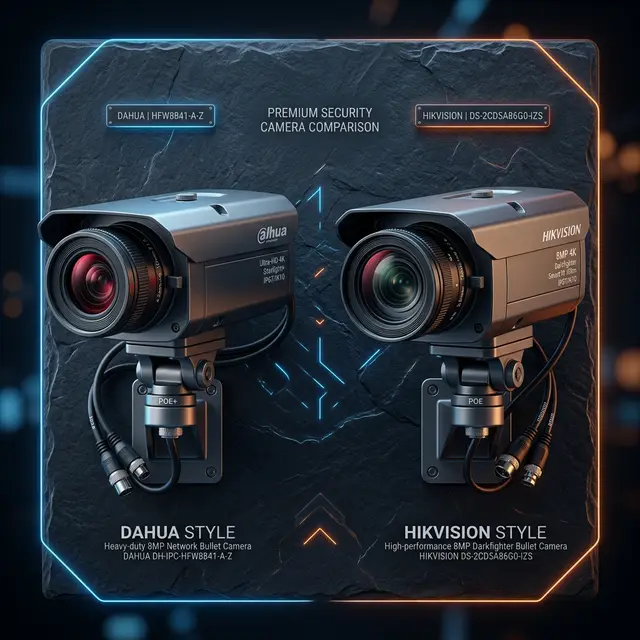
The Kosovo market has an abundance of "no-name" cameras or very cheap models. However, saving on hardware is one of those **security camera mistakes** that costs you double later.
A. Cheap Sensors vs Sony Starvis Sensors
A camera may say "4K", but if its sensor is small and cheap, the low-light image will be full of digital "noise". Technologies like Sony's Starvis or Hikvision's ColorVu are essential for 24/7 identification. Night vision isn't just about infrared LEDs; it's about sensor sensitivity.
B. Bitrate and Compression Hurdles
Cheap cameras use weak processors that compress video so much that every fine detail—like a license plate or a facial scar—is lost. In 2026, you should only use devices that support H.265+ with high bitrate profiles (minimum 8Mbps for 4K).
3. Weak Infrastructure: Cables, Power, and Storage
You can have the best camera in the world, but if the cable is weak, the system will fail. This is an aspect often overlooked by amateur installers in Kosovo.
The CCA (Copper Clad Aluminum) Trap
CCA cables are cheaper, but they have high resistance and oxidize quickly. After a year, the image will start to flicker or the camera will turn off completely. ElektroNova uses only 100% solid copper (CAT6/7) to ensure 10+ year longevity and proper PoE power delivery.
Lack of Power Redundancy
An intelligent thief will turn off the power before entering. If your system doesn't have a UPS (Uninterruptible Power Supply), it will shut down immediately. **Security camera mistakes** like this make your system entirely predictable and vulnerable.
The Storage Crisis: RAID 1 vs RAID 5
A single hard drive is a single point of failure. If that disk dies, your entire security history vanishes. For residential villas, we recommend RAID 1 (Mirroring), where data is written to two disks simultaneously. For enterprises, RAID 5 or RAID 6 provides maximum uptime even during multiple disk failures.

4. Cyber Security: "Open Door for Hackers"
Using "Default" Passwords
Many systems are left with passwords like "admin123" or "123456". Bots on the internet constantly scan for these devices. Changing the password and activating two-factor authentication (2FA) is mandatory.
Network Isolation (VLANs)
A critical mistake is putting cameras on the same network as your computers and guest Wi-Fi. If a camera is compromised, the hacker has access to your entire network. ElektroNova recommends creating an isolated VLAN (Virtual Local Area Network) just for the security system, blocking unwanted traffic between devices.
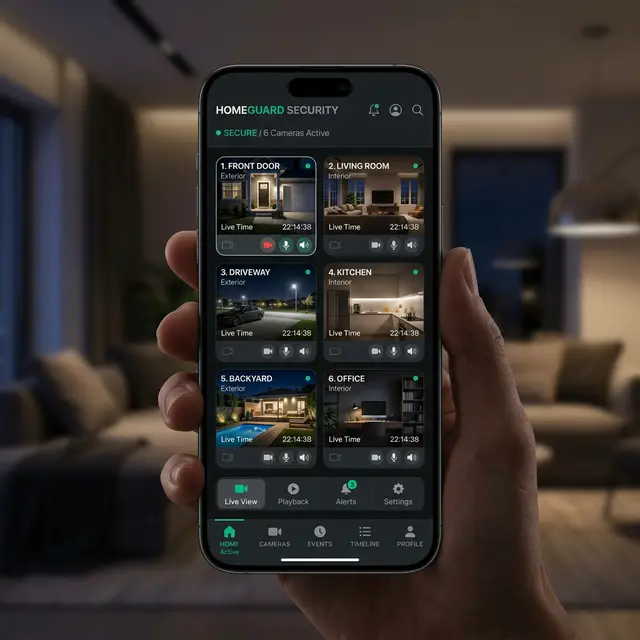
The Audio Mistake and Legal Consequences
Many people install cameras with an open microphone without knowing that recording audio in public spaces or without the consent of individuals is a serious legal violation in Kosovo. This can lead to heavy fines and civil lawsuits under the Law on Personal Data Protection.
When is audio allowed?
Audio recording should generally be restricted to internal private areas where privacy expectations are lower, and only after displaying clear signage indicating audio-visual monitoring. When in doubt, ElektroNova recommends disabling the microphone at the hardware or software level.
Case Study: The Villa in Peja and the "Saving" that cost €3000
A client in Peja self-installed a system with 8 Wi-Fi cameras bought online for 400 euros. The mistakes he made:
- The cameras were all on the same Wi-Fi channel as the house's Netflix.
- He didn't use a UPS, just standard external outlets.
- He mounted them too high under the eaves of the house.
The Result after 6 months:
During an attempted robbery, the thieves turned off the external power fuse. The cameras shut down immediately. Even if they had worked, the Wi-Fi was so overloaded that the recordings were jerky. The client lost equipment worth 3000 euros because his system failed at the only task it had.
After this, ElektroNova re-installed a 4K PoE system with UPS and network isolation. Today, that client has 24/7 security without a single failure.
The Mistake of Simple "Motion Detection" vs AI
Many people complain that they receive hundreds of notifications on their phone for every cat or car light passing by. This leads to "alarm fatigue", where you eventually turn off notifications altogether.
The Mistake: Motion Detection
Only analyzes pixel change. Any movement (trees, shadows, rain) triggers the alarm, leading to constant false positives.
The Solution: AI Human/Vehicle Detection
Uses neural network algorithms (like AcuSense or WizMind) to identify human or vehicle shapes. The alarm is triggered only when there is a real threat.
Maintenance: Why "Install and Forget" is a fatal error?
A security system is an active electronic device that works 24/7 in harsh atmospheric conditions. Neglecting it is one of those **security camera mistakes** that damages your investment.
Lens cleaning from dust and spider webs increases night clarity by 40% and reduces IR glare.
Hard Drive health control (S.M.A.R.T check) every 6 months prevents catastrophic data loss.
Updating Firmware protects the system from newly discovered vulnerabilities and zero-day exploits.
Physical Mounting Safety: More than just screws
One of those **security camera mistakes** that leads to physical damage is using the wrong anchors or drilling directly into delicate surfaces without proper precautions.
Concrete/Brick
Requires mechanical or chemical anchors to prevent micro-vibrations that trigger false analytics alarms during high winds.
EIFS Façades
Mistake: Drilling without sealing. Water can enter the house's insulation, causing structural moisture damage over 2-3 years.
Galvanic Isolation
Crucial when mounting on metal structures. Prevents electrical interference and electrochemical corrosion of the camera base.
Remote Access Vulnerabilities: Port Forwarding vs VPN
Many amateur installers open "ports" on your router to allow remote viewing. This is like leaving a window unlocked. Bots scan for open ports 24/7.
The **ElektroNova Standard** involves using an encrypted VPN tunnel (WireGuard or OpenVPN) at the router level. This ensures that your video stream is never exposed directly to the public internet, providing peace of mind even when you are thousands of miles away from Kosovo.
Building for 2026: GenAI and Semantic Search
The technological horizon is shifting. In 2026, we are witnessing the mass integration of **Generative AI** into security architectures. This goes beyond simple face detection.
Semantic Video Search
Instead of scrubbing through 24 hours of footage, you can simply ask the system: "Show me a person wearing a blue jacket who was carrying a package". The AI parses metadata across all cameras in milliseconds.
Behavioral Predictive Analytics
New systems can identify "pre-incident" behaviors—such as someone repeatedly checking a gate lock over several days—and alert you before a break-in even occurs.
The ElektroNova Standard: Why Fluke Testing Matters
Many installers in Kosovo simply terminate a cables and hope the "link light" turns on. This is one of the hidden **security camera mistakes** buried behind your walls.
At ElektroNova, every network drop is certified using professional Fluke Testers. This allows us to verify:
- Near-End Crosstalk (NEXT)
- Return Loss and Attenuation issues
- PoE Load Balancing over 100 meters
"A cable that works today can fail tomorrow if it has micro-fractures. Technical certification is the only true guarantee of your security investment's longevity."
Advanced Analytics: LPR and Thermal Vision
For properties that demand the highest level of protection, two technologies are becoming standard for luxury villas and industrial sites in Kosovo: **License Plate Recognition (LPR)** and **Thermal Imaging**.
LPR: Beyond just taking photos
LPR systems don't just photograph a car's plates; they convert the image into searchable text (OCR) and can compare it against a "Blacklist" or "Whitelist". If a suspicious vehicle passes by your villa, the system notifies you instantly, even in total darkness and at high speeds.
Thermal Imaging: Security in Total Darkness
A common mistake is believing that standard IR (Infrared) lighting is sufficient. In dense fog or over long distances, IR fails due to scattering. Thermal cameras detect body heat, capturing a person at 200+ meters even through fog, snow, or absolute pitch-black conditions where visibility is zero.
Conclusion
Security is not something that can be done halfway. By avoiding these **security camera mistakes**, you invest in your peace of mind. Remember: a security system is only as strong as its weakest link.
Don't make these mistakes!
Contact us today for a free consultation and ensure your installation is world-class.